Portfolio Company AI & Agentic Transformation Methodology
A private-equity operating model for identifying, ranking, governing, building, and scaling autonomous agentic workforces across portfolio companies.
For senior partners, operating partners, deal teams, and portfolio company leadership.
Agentic transformation as a private-equity value-creation lever
ColdAI helps private equity firms turn AI from a board-level talking point into a measurable portfolio operating system. The methodology starts where PE value creation starts — operating leverage, margin expansion, commercial acceleration, cash conversion, quality of earnings, and exit narrative — and only then layers in the technology to deliver it.
We identify where knowledge work is trapped inside manual workflows, underwrite the economic impact of agentic automation, and implement production-grade agents that operate under governance, compliance, and human accountability.
For a GP, the relevant question is not whether a portfolio company is using AI. The question is whether AI is being systematically converted into EBITDA uplift, faster revenue execution, lower SG&A intensity, better working-capital discipline, reduced key-person dependency, and a stronger exit story. ColdAI provides a methodology to answer that question company by company and then institutionalize the answer across the portfolio.
| PE value lever | ColdAI method | Value-creation outcome |
|---|---|---|
| Operating leverage | Automate repeatable manual workflows and reduce cycle times without weakening control environments. | Margin expansion, SG&A efficiency, faster close, reduced rework. |
| Commercial acceleration | Deploy agents across sales, marketing, customer success, pricing, bid management, and account research. | Pipeline velocity, win-rate improvement, retention, ARR/NRR expansion. |
| Portfolio playbook | Create reusable agent patterns that can be replicated across similar portfolio companies. | Faster value creation, lower transformation cost, shared capability curve. |
| Governed autonomy | Define policies, controls, approval rights, auditability, legal boundaries, and risk escalation. | Lower operational and compliance risk; board-ready governance. |
| Exit readiness | Document AI-enabled productivity, data maturity, operational resilience, and scalable digital labor architecture. | Higher-quality equity story and stronger strategic-buyer narrative. |
Why private equity needs an agentic transformation methodology
Private equity is structurally advantaged for agentic transformation — ownership control, operating discipline, clear hold-period objectives, and repeatable portfolio patterns. It is also structurally exposed: stretched exit windows, competitive deals, higher LP expectations, and rising AI expectations from strategic buyers mean generic AI pilots are no longer enough.
ColdAI treats each portfolio company as an investable operating system. We map workflows, quantify friction, identify agentic opportunities, rank them against the value-creation plan, and implement agents only where there is a clear business case, a defined control model, and a credible pathway to scale.
"This is not an IT transformation. It is an operating transformation with a technology engine. The sponsor-facing question is: where can autonomous digital labor improve the investment case during the hold period and strengthen the exit narrative at sale?"
| Investment lifecycle phase | ColdAI contribution |
|---|---|
| Pre-acquisition / diligence | Rapid AI value-creation scan, red-flag assessment, data maturity review, automation upside hypothesis, 100-day plan input. |
| First 100 days | Workflow baselining, priority agent backlog, governance framework, MVP agents for 2–4 high-value workflows. |
| Hold-period value creation | Transformation factory: build, deploy, monitor, and scale agents across departments and bolt-ons. |
| Add-on integration | Reusable agents for integration management, data mapping, customer overlap, procurement synergy, finance integration, and PMO. |
| Exit preparation | Documented productivity gains, governance maturity, AI-enabled operating model, buyer-ready data room assets, and technology narrative. |
ColdAI value-creation operating model
A bridge between private-equity value creation and AI engineering — designed to be understood by sponsors, accepted by operating partners, adopted by management, and implemented by technical teams. It avoids the two failure modes of AI transformation: strategy decks without production systems, and technical deployments without a board-level value case.
| Operating layer | Description |
|---|---|
| 1. Portfolio scan | Identify which companies have the strongest combination of manual workflow intensity, data readiness, management sponsorship, and value-creation urgency. |
| 2. Company diagnostic | Perform executive interviews, workflow shadowing, system review, data audit, and economic baseline analysis. |
| 3. Agentic opportunity backlog | Create a complete portfolio of agent opportunities across departments, ranked by business impact, complexity, risk, and speed to value. |
| 4. Transformation roadmap | Agree a 30/60/90-day and 12-month roadmap with department heads and the sponsor operating team. |
| 5. Agentic workforce build | Design, develop, test, integrate, and deploy agents using appropriate human-in-the-loop controls and observability. |
| 6. Value capture office | Track realized impact, adoption, risk incidents, cost to serve, process quality, and incremental value creation. |
The methodology is intentionally modular. A sponsor can use it for a single portfolio company, for a thematic vertical portfolio (healthcare services, software, industrials, B2B services), or as an institutionalized AI value-creation office across the fund.
Eight steps from workflow diagnostic to continuous value capture
Analyse Manual Workflows
Create the operating fact base before making technology decisions.
Define All Agentic Opportunities
Convert workflow friction into a complete agentic opportunity universe.
Rank by Impact & Effort
Underwrite agentic opportunities like a value-creation investment case.
Roadmap with Department Heads
Turn the ranked backlog into an executable operating plan owned by management.
Governance, Compliance & Legal
Define the rules of the agentic workforce before autonomy scales.
Design Your Agentic Workforce
Architect agents as digital employees with roles, permissions, tools, memory, escalation, and KPIs.
Develop & Implement Agents
Move from blueprint to production with engineering discipline and adoption design.
Monitor, Feedback & Improve
Operate agentic transformation as a continuous value-capture system.
Analyse Manual Workflows
Create the operating fact base before making technology decisions.
Identify high-friction, high-frequency, high-cost, and high-risk workflows where human capacity is being consumed by repeatable knowledge work. The goal is to create a CFO-grade baseline of time, cost, quality, delay, and control burden.
For PE, this step translates operational pain into investment language. It shows where manual workflows suppress EBITDA, slow revenue execution, create avoidable leakage, increase compliance exposure, or weaken scalability before exit.

- Interview the CEO, CFO, CTO/CIO, COO, CRO, CHRO, legal/compliance lead, and selected department heads.
- Run workflow shadowing sessions with frontline teams, not only executives. Capture the actual work, not the org chart version of the work.
- Map every major workflow by trigger, input, decision points, systems touched, handoffs, approval points, output, exception handling, and owner.
- Quantify manual effort using FTE hours, frequency, cycle time, backlog, cost per transaction, error rate, rework, and service-level misses.
- Identify data sources, system constraints, integration barriers, permission models, and shadow processes living in spreadsheets, email, Slack, Teams, PDFs, and legacy systems.
- Tag each workflow by value lever: cost takeout, growth enablement, working capital, risk reduction, customer experience, speed, or exit-readiness.
- Manual Workflow Atlas by department and process family.
- Cost-of-work baseline with FTE equivalent, cycle time, rework, and quality metrics.
- System and data dependency map.
- Workflow heatmap showing automation potential and sponsor relevance.
- Initial risk flags: regulated data, customer-facing judgment, legal exposure, labor implications, and operational resilience dependencies.
- "Which workflows would immediately improve margin if cycle time fell by 30–70%?"
- "Which workflows are only scalable by hiring more people today?"
- "Which processes create recurring bottlenecks before month-end, quarter-end, board reporting, customer onboarding, renewals, procurement, claims, or fulfillment?"
- "Where does management lack real-time visibility because the work happens in email, spreadsheets, or tacit knowledge?"
- "What manual work would become more painful if the company doubled revenue or integrated an add-on acquisition?"
Define All Agentic Opportunities
Convert workflow friction into a complete agentic opportunity universe.
Identify every plausible use case for autonomous or semi-autonomous agents across the company, including departmental agents, cross-functional agents, executive agents, data agents, integration agents, and control agents.
This step builds the deal-style opportunity backlog. It ensures the sponsor sees the full addressable value pool instead of a handful of disconnected AI pilots proposed by individual departments.
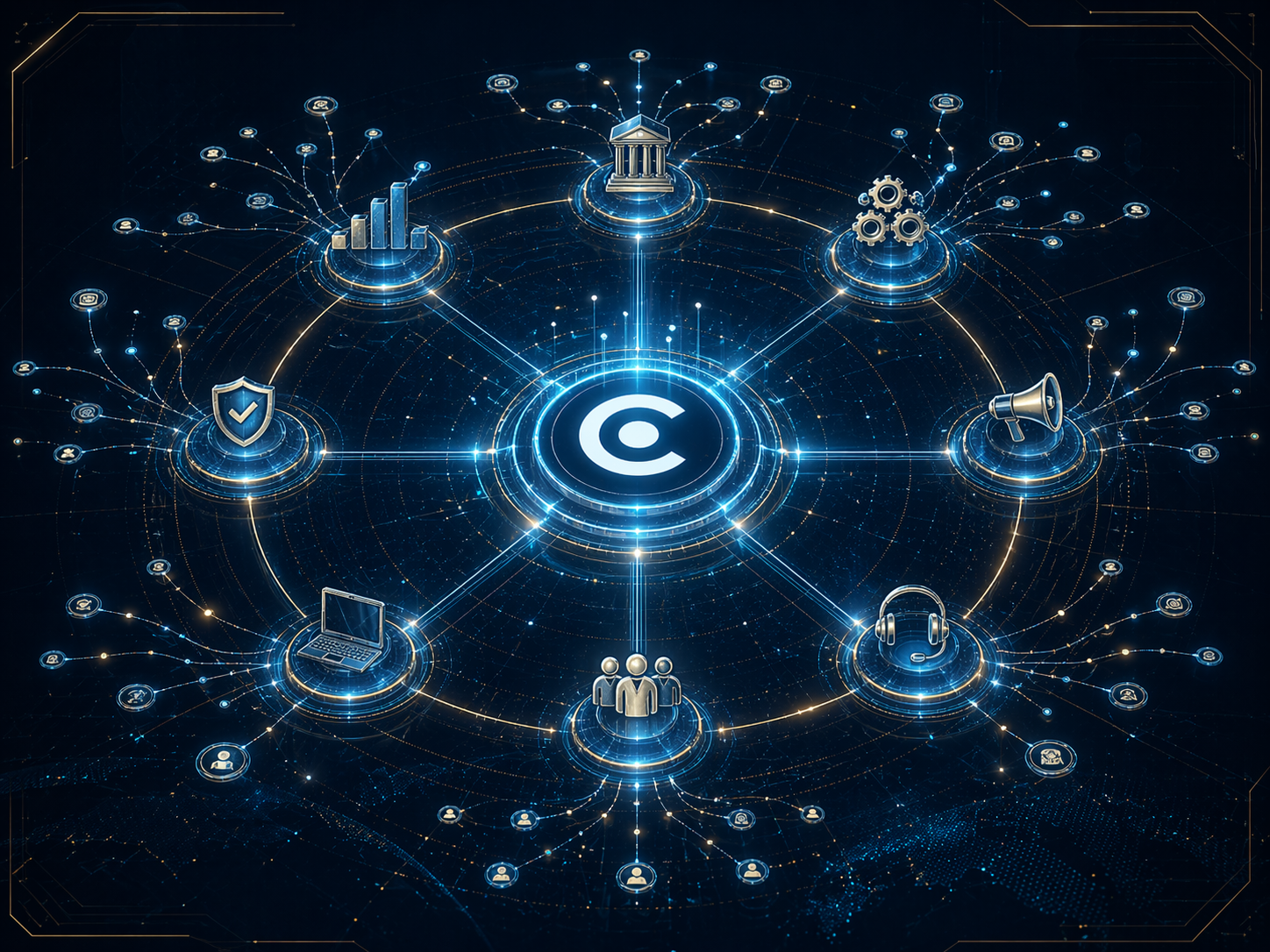
- Translate workflow maps into agent candidates with clear jobs to be done, inputs, outputs, permissions, and required human approvals.
- Separate simple automation, AI copilots, deterministic software, and true autonomous agents so the company does not over-engineer low-complexity tasks.
- Identify enterprise-wide agent patterns that can be reused across functions: document intake, research, reconciliation, customer communication, reporting, exception triage, quality assurance, and compliance review.
- Map agents to the sponsor value-creation plan: margin expansion, commercial acceleration, cash conversion, pricing, procurement, service delivery, and exit readiness.
- Identify quick wins, strategic bets, foundational enablers, and no-go zones where automation is currently too risky or economically weak.
- Agentic Opportunity Register with use case name, owner, workflow, value lever, autonomy level, data needs, systems, risk rating, and estimated value.
- Department-level opportunity maps for finance, sales, marketing, customer support, HR, procurement, operations, legal, IT, and product/engineering where relevant.
- Autonomy classification: assistive, supervised execution, controlled autonomous execution, or fully autonomous back-office execution.
- Reuse pattern catalogue for cross-portfolio deployment.
- "Which workflows require reasoning, judgment, synthesis, drafting, retrieval, exception handling, or orchestration across systems?"
- "Where can agents produce work products that humans review before external release?"
- "Which agents can be replicated across multiple portfolio companies?"
- "Where is the company confusing AI novelty with real operating impact?"
- "Which opportunities require data cleanup before automation can succeed?"
Rank by Impact & Effort
Underwrite agentic opportunities like a value-creation investment case.
Prioritize opportunities using a disciplined scoring model that balances economic upside, speed to value, strategic importance, operational complexity, data readiness, integration difficulty, risk, and change-management burden.
This is the IC discipline inside the methodology. PE firms do not need a list of use cases; they need a ranked capital-allocation view of where management attention, implementation budget, and sponsor oversight will produce the highest probability-adjusted return.

- Estimate economic impact using a bottom-up model: time saved, cost per hour, rework reduction, conversion improvement, cycle-time improvement, leakage reduction, and incremental revenue.
- Assess strategic impact against the investment thesis and value-creation plan: where the fund expects multiple expansion, margin lift, or growth acceleration.
- Score complexity: systems integration, data access, process variance, stakeholder fragmentation, required approvals, vendor dependencies, and testing burden.
- Score risk: regulatory, privacy, customer impact, hallucination tolerance, financial control exposure, legal exposure, model risk, and workforce implications.
- Build a phased portfolio of quick wins, scaled initiatives, and foundational enablers.
- Impact/Effort Matrix with clear cut-lines for build-now, design-next, monitor, and deprioritize.
- Use-case business cases with value logic, assumptions, sensitivity ranges, and risk mitigants.
- Prioritized 90-day backlog and 12-month agentic transformation portfolio.
- Board-ready summary of expected value capture and execution requirements.
- "What is the expected EBITDA effect if this agent reaches steady-state adoption?"
- "How quickly can value be realized within the hold period?"
- "Which use cases require CFO validation before being counted in the value-creation plan?"
- "What can be launched without core-system replacement?"
- "Where is the risk-adjusted ROI unattractive despite technical feasibility?"
Roadmap with Department Heads
Turn the ranked backlog into an executable operating plan owned by management.
Align management, department heads, sponsor operating partners, and ColdAI around a practical roadmap with owners, milestones, dependencies, KPIs, governance checkpoints, and value-capture expectations.
PE transformations fail when they are treated as side projects. This step creates operating cadence and accountability: the roadmap becomes part of management rhythm, sponsor oversight, and board reporting.

- Run department-level working sessions to validate assumptions, refine requirements, confirm owners, and identify dependencies.
- Sequence initiatives based on value, feasibility, readiness, change burden, and technical dependencies.
- Define 30/60/90-day milestones and 12-month scaling plan.
- Assign RACI across sponsor, management, ColdAI, IT, data, legal, compliance, HR, and frontline process owners.
- Create adoption plans: training, communications, SOP updates, human review responsibilities, and feedback mechanisms.
- Department-level roadmaps with milestones, owners, value expectations, and dependencies.
- Integrated portfolio company transformation roadmap.
- Decision log and dependency tracker.
- Executive steering committee cadence and board-reporting format.
- Change-management plan and adoption scorecard.
- "Which department head owns adoption and business value?"
- "What must be true before the agent can touch production data or external communications?"
- "Which initiatives require IT/security approval before sprint planning?"
- "What will the board see at the next quarterly review?"
- "Which quick wins create momentum without compromising risk discipline?"
Governance, Compliance & Legal
Define the rules of the agentic workforce before autonomy scales.
Together with the PE firm, portfolio company leadership, counsel, compliance, IT security, and risk owners, define the governance frameworks, compliance requirements, and legal cornerstones for the agentic workforce.
Governance is not a brake on value creation; it is what allows value creation to survive diligence, customer review, regulatory scrutiny, and exit. A buyer must believe that agentic automation is controlled, auditable, secure, and institutionally managed — not a collection of rogue bots.
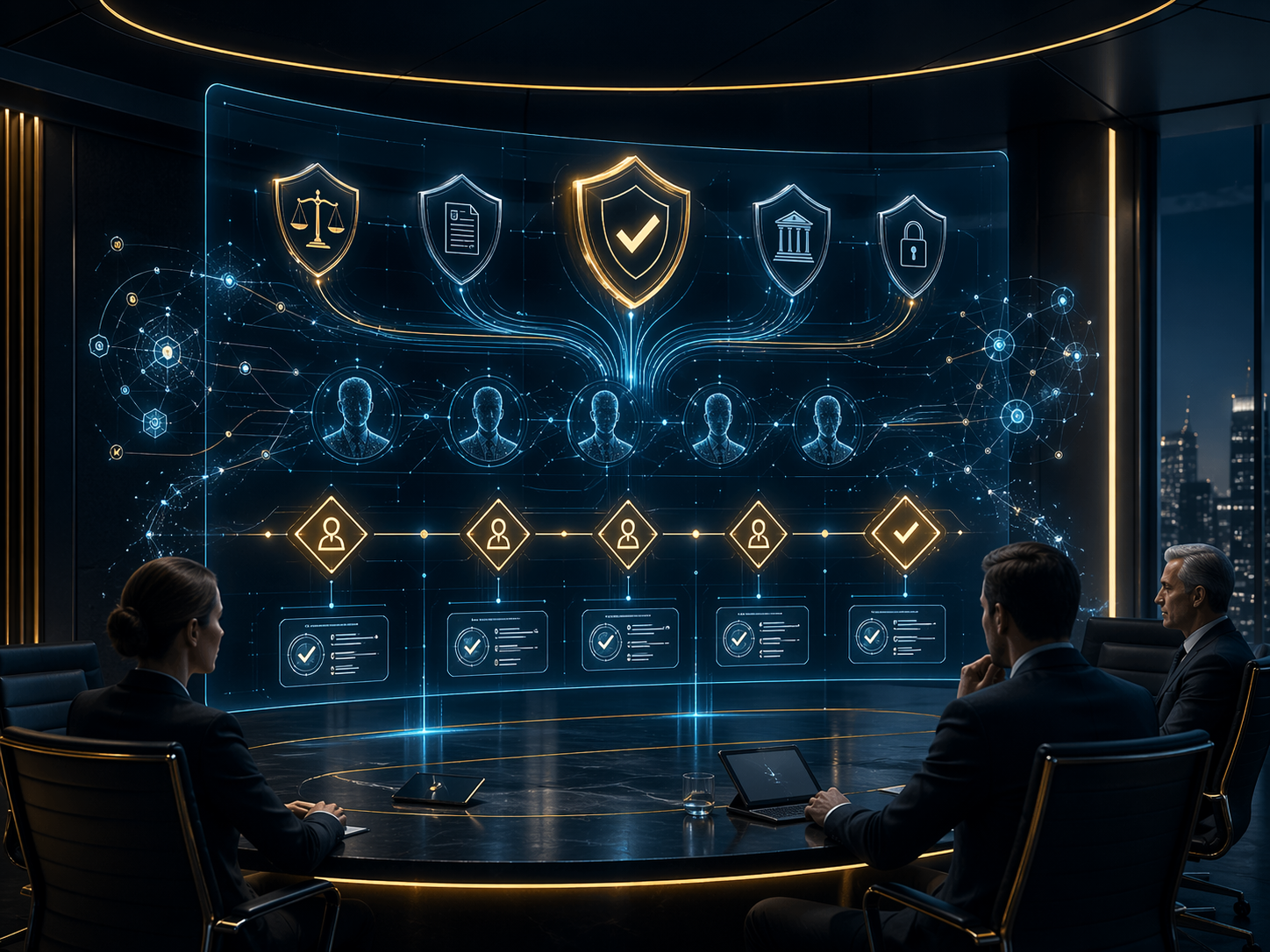
- Define AI governance principles: accountability, human oversight, transparency, auditability, data minimization, security, privacy, and escalation.
- Map applicable requirements by geography, sector, customer contract, data type, and business process.
- Classify agents by risk tier and autonomy level. Define which agents can draft, recommend, execute, communicate externally, approve, transact, or only observe.
- Establish human-in-the-loop and human-on-the-loop controls, approval thresholds, segregation of duties, and exception handling.
- Define logging, monitoring, retention, model evaluation, vendor management, incident response, and shutdown procedures.
- Review employment, works council, labor relations, customer disclosure, data processing, IP ownership, and contractual implications where applicable.
- Agentic Governance Framework and policy pack.
- Agent Risk Classification Matrix.
- Data access and permission model.
- Legal and compliance review checklist.
- Human oversight and approval policy.
- Incident response and audit-log requirements.
- Exit-ready AI governance data room folder structure.
- "Which agents can take action without human approval, and under what thresholds?"
- "What data is prohibited, restricted, or permitted for each agent?"
- "How will the company prove what an agent did, why it did it, and who approved it?"
- "What disclosures or contractual consents are required?"
- "Can the governance model withstand buyer diligence, customer audits, and regulatory review?"
Design Your Agentic Workforce
Architect agents as digital employees with roles, permissions, tools, memory, escalation, and KPIs.
Design the agentic workforce as an operating architecture rather than a set of disconnected bots. Each agent receives a job description, workflow scope, tool access, data boundaries, memory rules, escalation path, QA metrics, and business owner.
A portfolio company should not merely adopt AI tools; it should redesign how work gets done. This step turns agentic automation into scalable digital labor that can support organic growth, add-on integration, margin expansion, and exit-readiness.

- Define agent roles and responsibilities by function: Finance Agent, Sales Agent, Customer Success Agent, Procurement Agent, Legal Review Agent, Research Agent, Operations Agent, Data Quality Agent, and Executive Reporting Agent.
- Design agent workflows, triggers, tools, system integrations, knowledge bases, memory, user interfaces, approval points, and observability requirements.
- Determine the right architecture: single-agent, multi-agent, supervisor-worker model, retrieval-augmented agent, workflow-orchestrated agent, or deterministic automation with AI reasoning layers.
- Define non-functional requirements: reliability, latency, security, cost ceilings, uptime, fallback handling, model routing, and audit traceability.
- Design the human operating model: who assigns work to agents, who reviews outputs, who resolves exceptions, and who owns continuous improvement.
- Agentic Workforce Blueprint.
- Agent job descriptions and operating boundaries.
- Architecture diagrams and integration maps.
- Prompt, policy, retrieval, tool, and memory design specifications.
- Acceptance criteria, testing plan, and KPI definitions.
- Department-specific SOP changes for human-agent collaboration.
- "What is the minimum viable autonomy that creates value without creating unnecessary risk?"
- "Which agents should share memory or operate independently?"
- "Which systems does the agent need to read from and write to?"
- "What is the agent not allowed to do?"
- "What is the exception path when confidence is low or the decision is high impact?"
Develop & Implement Agents
Move from blueprint to production with engineering discipline and adoption design.
Build, integrate, test, deploy, and adopt agents in production environments. The implementation approach combines agile delivery with PE-grade value tracking, security review, model evaluation, and change management.
This is where the methodology becomes cash flow. PE firms need implementation velocity, but not at the expense of reliability. ColdAI uses a factory model to launch agents in waves, prove value, and then scale across departments and portfolio companies.

- Build MVP agents for priority workflows using approved architecture, data connections, tools, prompts, policy rules, and logging.
- Integrate with systems such as CRM, ERP, helpdesk, data warehouse, document repositories, email, calendar, finance tools, ticketing, and internal knowledge bases.
- Run testing: unit tests, workflow tests, red-team tests, regression tests, hallucination checks, security checks, cost tests, and human acceptance testing.
- Deploy agents in controlled production pilots with defined user groups, permissions, fallbacks, and monitoring.
- Train users, update SOPs, track adoption, and resolve process gaps.
- Scale successful agents into broader rollout once value and controls are validated.
- Production-ready agents deployed into approved workflows.
- Integration documentation and runbooks.
- Testing evidence and risk sign-off pack.
- User adoption materials and SOP updates.
- Go-live dashboard with impact, usage, quality, risk, and cost metrics.
- Scale plan for adjacent workflows and cross-portfolio replication.
- "What is the smallest deployable workflow that proves value quickly?"
- "What must be monitored daily during the first 30 days after launch?"
- "What is the rollback plan if performance or risk thresholds are breached?"
- "Which agents can be templatized for other portfolio companies?"
- "What adoption friction will prevent theoretical value from becoming realized value?"
Monitor, Feedback & Improve
Operate agentic transformation as a continuous value-capture system.
Monitor agents after deployment, collect feedback, improve performance, track realized value, manage risk, and continuously expand the transformation roadmap. Agents are treated as an operating capability that matures over time.
The sponsor needs proof of realized value, not anecdotes. This step creates the management cadence, dashboards, and evidence base required for board reporting, LP confidence, management accountability, and exit diligence.

- Monitor usage, task completion, cycle time, quality, exception rate, user satisfaction, cost per action, model spend, and business outcomes.
- Compare actual impact against underwriting assumptions and revise business cases with CFO validation.
- Collect human feedback, failure cases, near-misses, customer impact, and process exceptions.
- Improve agents through prompt revisions, retrieval improvements, tool changes, workflow redesign, model routing, and additional automation layers.
- Report performance to management and sponsor on a weekly/monthly basis, depending on transformation phase.
- Identify next-wave opportunities based on live operating data.
- Agent Performance Dashboard.
- Value Capture Tracker validated with finance.
- Risk and incident log.
- Continuous improvement backlog.
- Quarterly board and sponsor update pack.
- Exit-readiness evidence file: before/after metrics, governance, adoption, architecture, and value proof.
- "Is the agent producing realized value, or only activity?"
- "Which value assumptions have proven conservative, aggressive, or wrong?"
- "Where are users bypassing the agent and why?"
- "What failures indicate a process-design problem rather than a model problem?"
- "How will the next buyer diligence team validate the AI transformation story?"
Portfolio-level deployment model
ColdAI executes the methodology at three levels: single-asset transformation, thematic portfolio program, or fund-wide agentic value-creation office. The most powerful model is to identify common workflows across the portfolio, create reusable agent patterns, and deploy them through a repeatable implementation factory — moving a GP from bespoke projects to institutionalized operational alpha.
We recommend that PE firms begin with a two-part program: a portfolio scan to select the highest-potential assets, followed by a 90-day transformation sprint in one or two companies. The result is proof of value, reusable governance, and a sponsor-tested playbook that can be scaled across the portfolio.

| Deployment model | Best fit | Outputs |
|---|---|---|
| Single-asset transformation | One portfolio company with clear sponsor mandate and management buy-in. | Deep diagnostic, prioritized roadmap, production agents, value tracking. |
| Thematic portfolio sprint | Multiple companies with similar models, such as healthcare services, B2B services, software, industrial distribution, or professional services. | Common workflow patterns, shared agent templates, benchmarking, faster replication. |
| Fund-wide AI value-creation office | Institutional program across the portfolio and new deals. | Portfolio scan, governance standard, central agent library, executive dashboard, deal-team support. |
| Diligence acceleration | Target company evaluation before signing or shortly after close. | Automation upside hypothesis, risk flags, 100-day roadmap, technology/data readiness. |
| Add-on integration factory | Platform company pursuing roll-up strategy. | Agents for PMI, data harmonization, customer overlap, procurement, reporting, and SOP standardization. |
Metrics, reporting & investment-committee cadence
Agentic transformation must be measured with the same discipline as any other value-creation initiative. ColdAI separates activity metrics from value metrics and requires finance validation before impact is included in sponsor reporting.
| Metric family | Representative measures |
|---|---|
| Adoption | Active users, agent task volume, workflow coverage, review acceptance rate, department penetration. |
| Productivity | Cycle time, hours saved, tasks per FTE, backlog reduction, throughput, first-pass quality. |
| Financial impact | Run-rate savings, gross margin improvement, SG&A reduction, revenue acceleration, leakage reduction, working-capital impact. |
| Quality and risk | Error rate, hallucination rate, exception rate, incident count, policy violations, audit-log completeness. |
| Cost and scalability | Cost per task, model spend, infrastructure cost, maintenance burden, reuse potential. |
| Exit readiness | Documented operating model, governance maturity, scalable digital labor architecture, evidence of realized value. |
| Cadence | Management & sponsor focus |
|---|---|
| Weekly during sprint | Delivery progress, blockers, usage, defects, immediate risk flags, change-management issues. |
| Monthly | Value capture, adoption, roadmap updates, next-wave prioritization, sponsor operating team review. |
| Quarterly board | Portfolio company transformation status, realized impact, governance, risks, next-quarter priorities. |
| Exit prep | AI operating model narrative, realized value evidence, governance archive, buyer diligence materials. |
Illustrative departmental agentic use-case library
Illustrative, not prescriptive. The final backlog is always built from the portfolio company workflow fact base and the sponsor value-creation plan.
| Function | Illustrative agents | Value lever |
|---|---|---|
| Finance / CFO | Month-end close agent; invoice reconciliation agent; cash forecasting agent; board-pack drafting agent; variance analysis agent; audit support agent. | Faster close, lower controller burden, improved reporting quality, stronger lender/board cadence. |
| Sales / CRO | Account research agent; outbound personalization agent; RFP response agent; deal desk support agent; CRM hygiene agent; pipeline risk agent. | Higher sales productivity, improved win rate, faster response times, better pipeline quality. |
| Marketing | Campaign intelligence agent; content repurposing agent; SEO/GEO agent; competitor monitoring agent; creative testing agent. | Lower content cost, faster campaign iteration, improved demand generation. |
| Customer Success / Support | Ticket triage agent; knowledge-base answer agent; churn risk agent; renewal preparation agent; customer health summarization agent. | Lower support cost, faster resolution, improved retention and NRR. |
| Operations | Exception management agent; scheduling agent; quality inspection summarization agent; supplier follow-up agent; SOP compliance agent. | Throughput improvement, lower rework, better service levels. |
| Procurement | Vendor research agent; spend classification agent; contract comparison agent; negotiation prep agent; savings tracker agent. | Procurement savings, better vendor leverage, reduced leakage. |
| Legal / Compliance | Contract review triage agent; policy monitoring agent; compliance evidence agent; regulatory change monitor; DPA/contract clause comparison agent. | Lower legal bottlenecks, improved control evidence, reduced risk. |
| HR / People | Candidate screening support agent; onboarding agent; policy Q&A agent; training agent; workforce planning analytics agent. | Lower HR admin burden, improved onboarding, better workforce visibility. |
| IT / Security | Access review agent; ticket routing agent; vulnerability summarization agent; vendor security questionnaire agent; incident response documentation agent. | Faster IT response, improved security governance, lower repetitive work. |
| Executive / Sponsor reporting | Weekly operating memo agent; board pack assistant; KPI commentary agent; value-capture tracker agent; integration PMO agent. | Better management cadence, sponsor visibility, exit evidence. |
Impact & effort scoring matrix
A 100-point score to prioritize agentic opportunities. Weights can be tuned by investment thesis, sector, hold-period stage, and sponsor objectives.
| Criterion | Weight | Scoring logic |
|---|---|---|
| EBITDA / cash impact | 25 | Run-rate savings, margin improvement, working-capital impact, cost avoidance. |
| Revenue / growth impact | 20 | Pipeline acceleration, win-rate improvement, retention, pricing, customer expansion. |
| Speed to value | 10 | Can produce measurable value within 30–90 days. |
| Strategic relevance | 10 | Aligned with value-creation plan, exit narrative, add-on strategy, or competitive differentiation. |
| Data readiness | 10 | Required data is accessible, clean enough, permissioned, and usable. |
| Integration complexity | 10 | Ease of connecting required systems and APIs without major remediation. |
| Operational risk | 10 | Risk of harm, compliance exposure, customer impact, financial control risk. |
| Change-management burden | 5 | Stakeholder willingness, process stability, training burden, adoption difficulty. |
Private-equity diligence question bank
| Area | Question |
|---|---|
| Management | Where do leaders believe the organization is constrained by manual work, slow decisions, or lack of analytical capacity? |
| Finance | Which month-end, reporting, forecasting, billing, AR/AP, audit, and variance workflows consume the most recurring effort? |
| Commercial | Where does the company lose revenue because response times, personalization, account research, or follow-up are inconsistent? |
| Operations | Which service delivery workflows scale linearly with headcount and could become bottlenecks under growth or add-on integration? |
| Data and IT | Which systems hold critical data, what access constraints exist, and where are the shadow systems? |
| Risk and legal | Which workflows involve regulated data, external commitments, customer impact, financial control, or legal interpretation? |
| HR and change | Which teams are likely to adopt agentic tools quickly, and where will workforce concerns need careful management? |
| Exit readiness | What AI-enabled improvements could be credibly shown to a buyer in 12–24 months? |
Selected public context
This methodology reflects ColdAI's positioning and the current PE market conversation around AI value creation.
- Bain & Company — Field Notes from the Generative AI Insurgency in Private Equity, Global Private Equity Report 2025.
- BCG — Inside the AI-First Private Equity Firm.
- KPMG — Generative AI for Private Equity and portfolio company value creation.
- McKinsey — Harnessing the power of gen AI in private markets.
Run a portfolio scan with ColdAI
We start with a 2–4 week portfolio scan and a 90-day transformation sprint in one or two companies. The output is proof of value, reusable governance, and a sponsor-tested playbook you can scale across the fund.